Royal National Lifeboat Institution
Lifeboats in Action
Frightened, exhausted, in a battered yacht being tossed by high seas, a sailor makes a desperate ‘mayday’ call.
Days later, he and his crew will think about how they survived their ordeal.
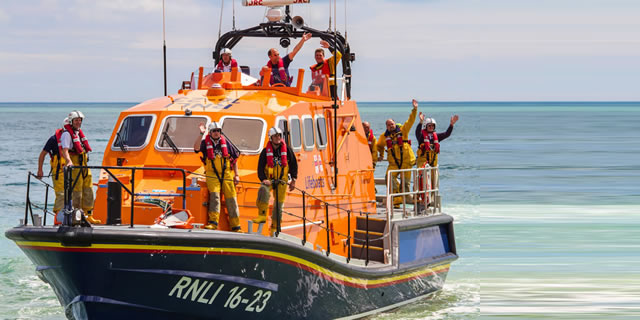
They will remember the glimpse of an orange and blue lifeboat; her crew risking their lives amid huge waves to leap aboard the stricken vessel.
They will remember being taken to the safety of the lifeboat and the feeling of relief that washed over them.And they will know that those RNLI volunteers saved their life.
The Royal National Lifeboat Institution
The RNLI is a registered charity that saves lives at sea. It has provided a 24-hour on-call lifeboat service to cover search and rescue requirements out to 100 nautical miles from the coast of the United Kingdom and the Republic of Ireland since 1824. The RNLI is recognised as one of the most efficient lifeboat services in the world. There are 235 lifeboat stations, not only around the coast but also on inland waterways, lakes and the River Thames. They are manned by highly trained, largely volunteer crews and every penny spent to maintain the lifeboat service is raised from voluntary contributions and legacies for its income. The RNLI is proud of its independence from Government status yet works with the Maritime Coastguard Agency, the Irish Coast Guard and other organisations to provide a co-ordinated rescue service.
Since the RNLI was founded its lifeboats have saved more than 139,000 lives. More and more people are using the sea for leisure and lifeboat crews are responding to an increased number of incidents relating to people engaged in recreational pursuits.
The Lifeboat Crew
Lifeboat crews are mostly volunteers, who come from all walks of life, and give up their time and comfort to carry out rescues and save lives at sea on the lifeboats. With over 4,800 lifeboat crew members in the United Kingdom and Republic of Ireland, of which over 340 are women, lifeboat crews are dedicated and make a major commitment – which could ultimately include risking their life. They respond at a moment's notice, no matter where they are or what they are doing when the pager goes off. Crews are regularly called away from their families, their beds and their work, 24 hours a day, 365 days a year. Often they’ll leave a place of work or comfort to readily exchange leisure and sleep to brave cold, wet and fatigue in situations that test their skill, strength and courage. Their lifesaving work is essential, often difficult and sometimes dangerous.
RNLI volunteers across the UK and Republic of Ireland are united by a willingness to commit time and energy to a cause about which they are passionate. It is because so many crewmembers, shore helpers, fundraisers and others are volunteers that such a high proportion of funds can be spent on first-class lifeboats and equipment.
They have one thing in common: they selflessly make time in their own lives to save others. These days, less than 10% of crew members come from maritime backgrounds. So it is essential that the RNLI provides first class training to make sure its crews have the skills they need to save lives
Eastbourne Lifeboat Station
A station was established in Eastbourne in 1822, two years before the Royal National Lifeboat Institution itself was founded. The Institution
did not take over the Station until 1853. Boathouses for the lifeboats have been in a number of locations over the years. The first being in Marine Road and Marine Parade, then at the bottom of the Wish Tower slopes. In 1903 a new boathouse was built at the Fishing Station in Royal Parade. This is still in use today for housing Eastbourne’s Inshore Lifeboat.
The All Weather Lifeboat (AWB)
“The Royal Thames” Operational Number 12-36 named by Her Royal Highness Princess Michael of Kent on Monday 6th September 1993 in Sovereign Harbour where she is moored. The lifeboat is one of the R.N.L.I. designed Mersey Class of Lifeboats made of fibre reinforced composite material, which is extremely strong. The lifeboat is powered by two Caterpillar 3208T V-8. This engine fit gives a typical maximum speed of 16 knots. The cost of this Lifeboat was in excess of £750,00.
The Inshore Lifeboat (ILB)
“The Joan and Ted Wiseman 50” Operational Number D – 605.The first of the new breed of inshore lifeboat to be issued to the coast known as an IB1. The £24,000 cost of the boat was met by a Middlesex couple who wished to mark their 50th Wedding Anniversary in a special way.
With the tighter dimensions, less elastic material, improved floor boarding system and a pod to house electronics, anchor, anchor rope, and fist aid kit the new boat is some 50% faster than some of the older inflatable boats.
Fitted with a new 50HP engine the boats are very responsive to helm input and rapid for transiting to a search area or casualty
The Call-outs at Eastbourne for 2010
The Eastbourne Lifeboat Station is recognised as being one of the busiest in the country. The two lifeboats were called out a total of 122 times during 2010. The Inshore Lifeboat launched on 70 occasions and the All-weather Lifeboat 52 times rescuing 118 persons. The call-outs were to a varied amount of incidents ranging from commercial fishing boats, leisure sailors, wind-surfers, pleasure boats, angling boats, dive boats, swimmers, dinghies, inflatables and persons cut off by the tide. Sadly, some call-outs are to recover casualties from the rocks at Beachy Head. Find out more about Eastbourne’s Lifeboats by visiting the website at
www.eastbourne@rnli.org.uk
This year at the 999 Display you will have the opportunity to meet with the crews of the Eastbourne All Weather Lifeboat and the Inshore Lifeboat.
Both lifeboats will be demonstrating their skills and techniques at sea in front of the Display area. It is anticipated the new Coastguard Helicopter from Lee-on-Solent will be exercising with the lifeboats to demonstrate how they winch a crewmember down and recover from a lifeboat. Other sea borne demonstrations will also take place during the two days of the Show.
Souvenirs will be available to purchase from our Fundraising stall located in the RNLI marquee. The RNLI’s Beach and Sea Safety Scheme for youngsters will be a major part of our static displays. Representatives from these will be there to encourage young people to be safe on the beach and at sea with competitions and displays to see. Come along and see us over this exciting weekend.
Six out of ten RNLI launches are only possible thanks to gifts in Wills.
As a charity, the RNLI relies on your support to carry on saving lives at sea.